
This month, we have a question from a reader: How do musicians read their music and watch the conductor at the same time? Do they have their music memorized?
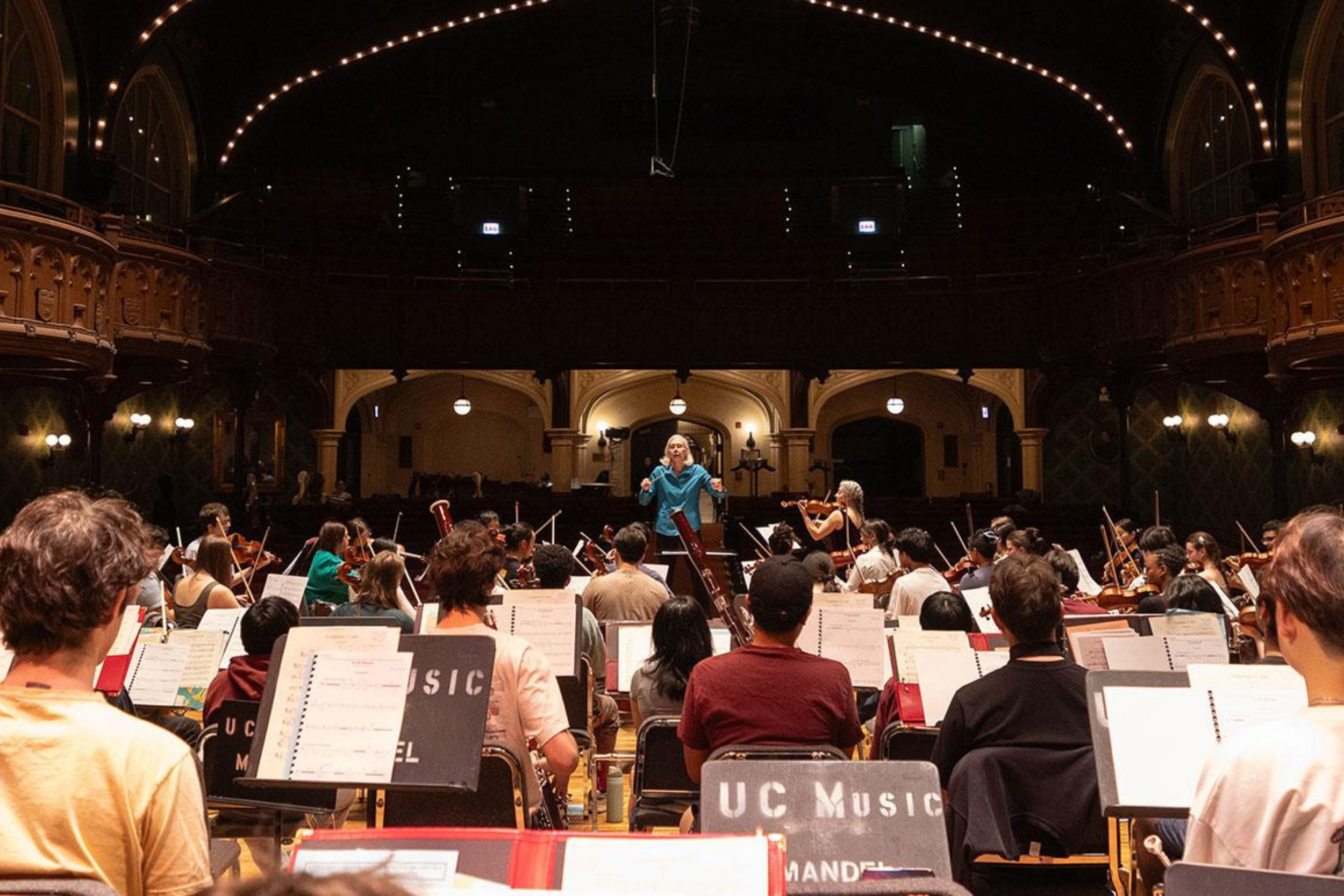
No, most orchestral musicians don’t have the music memorized. However, after hours of practice and rehearsals, they do often know their music very well. Musicians often have a few measures memorized here and there throughout the piece or they’ll look ahead in their music a few bars while performing to remember what they need to play next. Think of it like giving a speech: if you’ve written the speech ahead of time and practiced it repeatedly, the printed speech becomes more of a guide when you present it live: you may read some sections directly from the page, but you’ll also have phrases and snippets memorized that you’ll say from memory as you glance through the document.
Another great analogy that gives insight as to how a musician navigates their attention between the conductor and their sheet music is like driving. While you drive, you don't stare at the speedometer the entire time, but you do check it regularly while keeping your attention on the road. Your eyes may flit between speedometer, your navigation app, and the road, sometimes focusing on any of those things more or less depending on what’s happening in that moment. In an orchestra (or any other large ensemble of musicians), a musician's eyes move between the sheet music, the conductor, and oftentimes other musicians nearby as well. While they spend much of their time looking at the music (like a driver is primarily watching the road), they look up at especially important moments, such as the beginning of a piece, a change in tempo, a tricky entrance, or the end of a section. The conductor uses gestures, facial expressions, and body movement to communicate things like timing, volume, energy, and when to start or stop. Musicians also listen closely to one another, so they aren't relying on the conductor alone. And much of the time, musicians can see the conductor out of their periphery even when not looking directly at them.
Overall, playing in an orchestra requires a remarkable amount of multitasking. Musicians are reading music, listening to each other, watching the conductor and other musicians, counting, and coordinating their movements and breathing with each other, all at once. After years of practice, much of this becomes second nature, leaving them free to focus on making music together.
Do you have a musical question? Submit it here tof get it answered!
So What Does A Conductor Actually Do?
What does a conductor actually do? This is a great video of what a conductor does to shape a performance.