
Guided listening meant to help you hear a piece of music in a new way.
Symphony no. 7, Movement 2 by Ludwig van Beethoven
8 Minutes
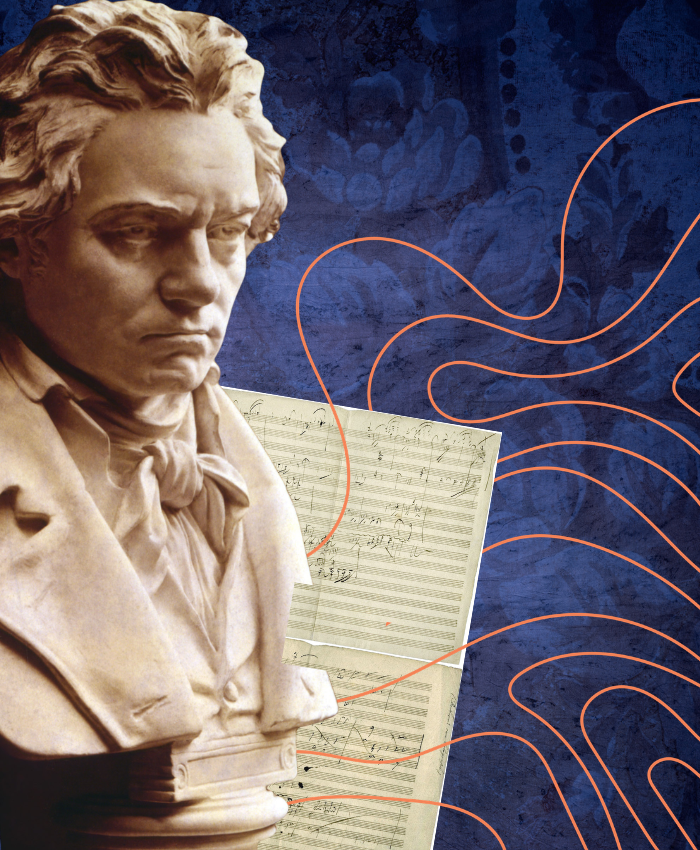
The second movement of Beethoven’s Seventh Symphony is built around a short, persistent rhythm that appears again and again throughout the music. For this piece, we suggest turning on the music and sitting or lying down with your eyes closed to fully immerse yourself in its repeated rhythm.
Your listening challenge:
As you listen, focus only on this rhythm:
LONG-short-short-LONG-LONG
It begins quietly in the low strings. As the music starts, try tapping the rhythm with your finger as you listen. Keep tapping as other instruments enter, the melody changes, and the music grows louder. Can you continue to hear the same rhythm, even as the piece grows?
Sometimes the rhythm is just in the background and sometimes it’s part of the main melody. Try and listen to hear the rhythm’s place in the music, whether it’s playing a supporting role or it’s front and center.
That rhythm has fascinated listeners for generations. Many have heard it as a solemn procession, and some have imagined a funeral march. That idea became especially associated with the movement told through stories told after Beethoven’s death. But there is no reliable evidence that Beethoven intended it to represent a funeral or any other specific event. To do this day, we really don’t know if Beethoven chose the rhythm because he liked it or if it meant to signify something more important.
So, what do you hear in those three notes? Does the rhythm sound like a procession? A heartbeat? Something else?There isn't a right answer. Part of the fun is hearing how much meaning we can find in a rhythm that Beethoven never explained for us.
About the Music
Beethoven wrote his Seventh Symphony in 1811 and 1812, during a difficult period in his life. By this point, his hearing had deteriorated severely, making conversation increasingly difficult and contributing to his growing isolation. At the same time, he was writing music filled with movement, energy, and strong rhythmic patterns. The Seventh is sometimes described as one of Beethoven’s most rhythmically driven symphonies, and its four movements all make striking use of repeated rhythmic ideas.
The symphony premiered in Vienna in December 1813, with Beethoven himself conducting. The concert was held to benefit soldiers wounded in the Napoleonic Wars and included several prominent musicians of the day. It was an immediate success, with the second movement in particular receiving such a strong response that the audience reportedly demanded it be repeated. More than 200 years later, that movement remains one of Beethoven’s most recognizable examples of how a simple rhythmic idea can carry an entire piece of music.
Take A Listen
Some key moments:
0:11: The rhythm starts in the low strings and it slowly builds and layers into it creates a melody.
0:55: A new melody is added on top of our rhythm, which now becomes harmony. Or does this new musical line become a harmony that supports our original rhythmic melody? What do your ears think - what stands out?
3:10: The rhythm has continued for 3 minutes, and now it finally changes slightly to LONG-short-short-LONG-short short.
4:35: That repeated rhythm we know and love is back!
And then the piece ends as simply as it began, with the LONG-short-short-LONG-LONG rhythm as the star of the show.